Using the app
Mark-price gap tracker
Over a thousand perpetuals on Binance and OKX are watched for the moment the traded price or the top of the book pulls away from mark price. That separation is usually the first visible sign that a book has thinned out — often before the liquidations arrive.
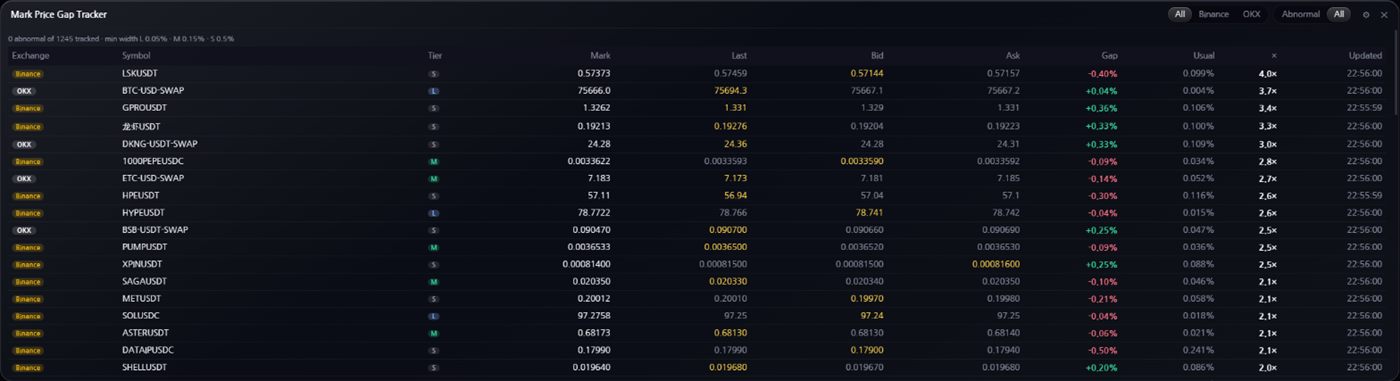
What the gap is
Mark price is the exchange’s fair value, built from a spot index rather than from the futures book, and it is what your liquidation price is measured against. The tracker compares it with three things the book is actually showing — the last trade, the best bid and the best ask — and reports whichever has moved furthest away.
A positive gap means the futures side is trading above mark; a negative gap means below. The Tier column marks the symbol as large, mid or small cap.
Theoretical background
On a perpetual, mark price is normally derived from a spot index rather than from the futures book. Spot and futures therefore share an anchor, and under ordinary volatility they move together: both sides reprice at once and the distance between them stays close to its usual width. Ordinary volatility, however violent, does not on its own open a gap.
A gap opens when the futures side moves and spot does not follow. The last trade or the top of the book runs away from the index, which means the move is being driven by futures order flow rather than by a repricing of the asset — forced closes hitting a book that has thinned out, each fill dragging the next one further. That is the shape of a futures-led overshoot, and usually of a cascade already under way.
This is what makes the gap a useful objective reading of a futures squeeze. It does not ask you to judge whether a move looks violent. It measures the one thing that separates a squeeze from ordinary volatility: whether the futures side is moving on its own.
How “abnormal” is decided
A flat threshold does not work here. Two tenths of a percent is extreme for BTC and ordinary noise for a thin small cap. So each symbol is measured against itself:
- The terminal keeps a rolling usual gap for every symbol — the
Usualcolumn. - A row is flagged when the current gap exceeds that usual value by a configurable multiple — the
×column. - It must also clear a minimum width for its market-cap tier, so a symbol with an unusually tight book cannot trip the alert on a movement that is meaningless in absolute terms.
Both conditions have to hold. The header line always states the thresholds currently in force and how many symbols are being tracked.
When the app starts, each symbol needs a few minutes of observation before its usual gap means anything. The header says building usual-gap baselines while that is happening, and rows carry a marker until their own baseline has settled.
Filters
- All / Binance / OKX — which venue to show.
- Abnormal / All — only flagged rows, or the whole tracked universe. Abnormal is the useful default; All is for inspecting a specific symbol.
Rows are ordered by how far above its own usual level each symbol currently sits.
Settings
The gear opens the judgement thresholds: the multiple, and the minimum width for each of the three tiers.
Automatic is on by default and follows StellarMom’s recommended values, which are maintained on the server and updated as the market changes. The fields stay visible but locked, with the time of the last update shown. Turn it off to use your own numbers.
Reading it in a real move
One abnormal symbol is usually its own story — a delisting, a stale market, a single large order. Many symbols going abnormal at once is a market-wide event, and that is precisely the condition the cascade alert watches for, combined with a surge in liquidation volume.
A dislocation says the book is thin right now. It does not tell you which way price resolves, and a wide gap can close as quickly as it opened.